The BOSS DD-200 is a versatile digital delay pedal‚ offering a wide range of delay types and extensive control. Comprehensive manuals and guides are readily available online.
Overview of the DD-200
The BOSS DD-200 Digital Delay is a powerhouse of sonic possibilities‚ packed into a compact and durable pedal. It’s designed for guitarists and other musicians seeking a comprehensive delay solution‚ offering everything from pristine digital echoes to warm analog-style repeats and creative modulated effects.
As part of the 200-Series‚ the DD-200 boasts exceptional sound quality and a user-friendly interface. Online resources‚ including the official BOSS website and dedicated communities like Reddit’s r/guitarpedals‚ provide extensive support. Detailed manuals and parameter guides are available to help users unlock the full potential of this versatile pedal‚ ensuring a seamless and inspiring creative experience.
Key Features and Specifications
The DD-200 delivers twelve distinct delay modes‚ encompassing standard digital‚ tape‚ analog‚ and unique specialty effects. It features 99 user-writable patches for storing custom delay settings‚ accessible via direct selection or MIDI control.
Crucially‚ the DD-200 operates on MIDI Channel 5. Its specifications include 24-bit A/D and D/A conversion‚ a wide frequency response‚ and support for external expression pedal control. Comprehensive user manuals detail all parameters and functionalities. Resources like cheat sheets‚ created by the online community‚ summarize key features for quick reference‚ streamlining the user experience.

Getting Started with Your DD-200
Begin by carefully unboxing your DD-200 and consulting the official BOSS owner’s manual for detailed setup instructions and operational guidance.
Unboxing and Initial Setup
Upon receiving your BOSS DD-200‚ carefully unpack the box and verify all included items. You should find the DD-200 pedal itself‚ along with any accompanying documentation – crucially‚ the owner’s manual. Before connecting anything‚ take a moment to visually inspect the pedal for any signs of shipping damage.
The initial setup involves familiarizing yourself with the pedal’s connections. Locate the input and output jacks‚ the power input‚ and the expression pedal jack. Refer to the manual for a detailed diagram of the pedal’s rear panel. Ensure you have a suitable power supply (typically a BOSS PSA-120) before proceeding to power up the unit. Proper setup ensures optimal performance and prevents potential issues.
Powering the DD-200
The BOSS DD-200 requires a stable 9V DC power supply to operate correctly. BOSS recommends using the PSA-120 series adapter‚ ensuring consistent performance and avoiding potential noise or malfunction. While other adapters may work‚ compatibility isn’t guaranteed‚ and could void the warranty.
Plug the DC plug into the DC IN jack on the rear panel. The DD-200 does not operate on batteries. Once connected to power‚ the pedal will illuminate‚ indicating it’s ready for use. Always disconnect the power supply when making any connections or adjustments to avoid unwanted sounds or potential damage to your equipment.
Input and Output Connections
The DD-200 features standard ¼-inch input and output jacks for connecting to your guitar and amplifier‚ respectively. Use high-quality instrument cables to ensure optimal signal transfer and minimize noise. The INPUT jack accepts a mono signal from your instrument. The OUTPUT jack sends the processed signal to your amplifier or the next pedal in your chain.
Additionally‚ there’s a dedicated stereo output for creating spacious delay effects. Proper cable connections are crucial for achieving the desired sound and avoiding signal issues. Ensure all connections are secure and free from loose plugs.
Understanding the DD-200 Interface
The DD-200’s interface includes a clear display‚ intuitive knobs‚ and switches for parameter adjustments. Consult the owner’s manual for detailed control explanations.
Panel Layout and Controls
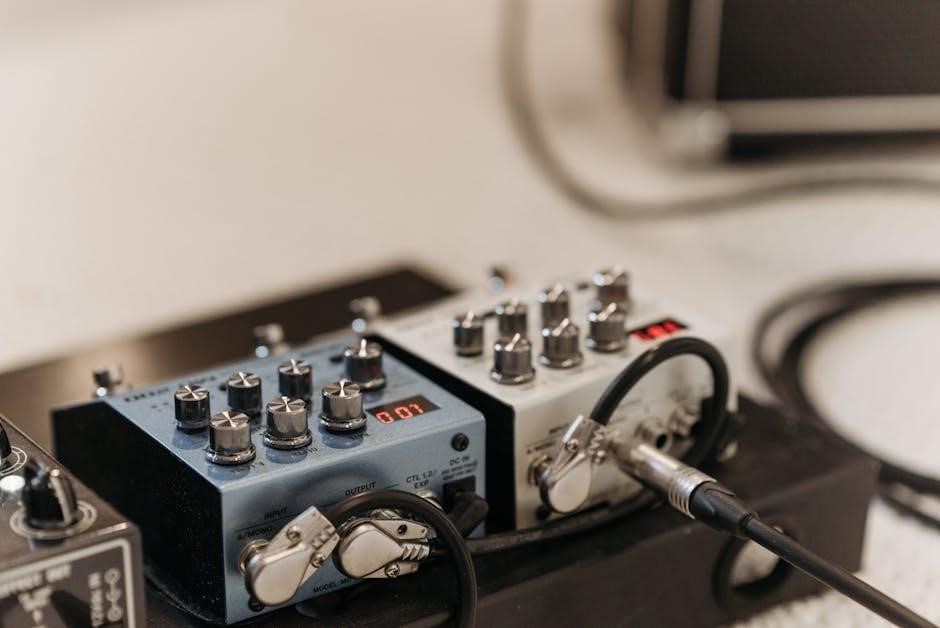
The BOSS DD-200’s front panel is logically organized for efficient operation. Several knobs govern essential parameters like Delay Time‚ Feedback‚ Level‚ and Width‚ allowing precise sound shaping; Dedicated buttons select delay modes – Standard‚ Modulation‚ Tape‚ Analog‚ and more – offering diverse sonic textures.
A prominent display provides visual feedback on selected settings and waveforms. Foot switches enable manual delay control and patch selection. The panel also features an expression pedal input for real-time parameter manipulation. Thoroughly reviewing the owner’s manual will unlock the full potential of each control‚ ensuring optimal performance and creative exploration with this powerful delay pedal.
Display and Navigation
The DD-200 features a clear‚ backlit LCD display that provides crucial information about your current settings. This includes the selected delay mode‚ parameter values for Delay Time‚ Feedback‚ Level‚ and more. Navigation through menus is achieved using a combination of dedicated buttons and the data encoder.
The display visually represents delay waveforms‚ aiding in precise adjustments. The manual details how to access advanced settings and customize the display’s brightness. Understanding the display’s layout and navigation system is key to unlocking the full potential of the DD-200’s extensive features and creating unique delay sounds.
Knob and Switch Functions
The DD-200’s intuitive interface utilizes a combination of knobs and footswitches for real-time control. Dedicated knobs adjust core parameters like Delay Time‚ Feedback‚ and Level‚ offering immediate adjustments. Footswitches engage/disengage the effect and allow for manual delay time tapping.
The manual thoroughly explains each knob and switch’s function‚ including secondary parameters accessed via the data encoder. Understanding these controls is vital for shaping your delay sounds on the fly. Experimentation with these functions unlocks the DD-200’s expressive capabilities‚ allowing for dynamic and nuanced performances.

Delay Types and Parameters
The DD-200 boasts standard‚ modulated‚ and specialty delay modes—like tape and analog—each with adjustable parameters for extensive sonic customization.
Standard Delay Modes
The BOSS DD-200’s standard delay modes provide the foundation for classic delay sounds. These include Digital‚ Analog‚ and Tape‚ each offering distinct characteristics. Digital delivers pristine‚ clear repeats‚ while Analog emulates the warm‚ slightly degraded tone of older analog delay circuits. The Tape mode authentically recreates the saturation and subtle pitch fluctuations of vintage tape echo units.
Parameters within these modes allow precise control over Delay Time‚ Feedback‚ and Level. Users can adjust these to create everything from subtle slapback echoes to long‚ cascading repeats. The DD-200’s high-quality converters ensure that these standard modes deliver exceptional clarity and fidelity‚ making them suitable for a wide range of musical styles.
Modulated Delay Modes
The DD-200’s modulated delay modes introduce dynamic movement and texture to your delay sounds. Chorus‚ Flanger‚ Phaser‚ and Tremolo are among the options‚ adding swirling‚ pulsating‚ or rhythmic effects to the repeats. These modes utilize built-in modulation effects applied to the delay signal‚ creating rich and evolving soundscapes.
Depth and Rate controls allow users to customize the intensity and speed of the modulation. Experimenting with these parameters can yield subtle enhancements or dramatic‚ otherworldly textures. These modulated delays are perfect for adding depth to clean tones‚ creating psychedelic soundscapes‚ or adding rhythmic interest to lead lines.
Specialty Delay Modes (Tape‚ Analog‚ etc.)
The DD-200 excels with its emulations of classic delay types. Tape delay modes recreate the warm saturation‚ subtle pitch fluctuations‚ and inherent noise of vintage tape echo units. Analog modes simulate the character of older analog bucket-brigade delays‚ offering a darker‚ more rounded tone.
These specialty modes aren’t simply imitations; they offer adjustable parameters to fine-tune the emulation. Users can control tape age‚ wow & flutter‚ and input level for tape modes‚ or modulation and tone for analog modes. These features allow for a wide range of sonic textures beyond simple replication.

MIDI Implementation for the DD-200
The DD-200 utilizes MIDI for patch changes and effect control. It’s assigned to MIDI Channel 5‚ enabling seamless integration with other MIDI-equipped gear and controllers.
MIDI Channel Assignment
The BOSS DD-200 is pre-configured to operate on MIDI Channel 5. This dedicated channel allows for focused control without potential conflicts with other MIDI devices in your setup. However‚ the DD-200 allows users to adjust this setting within the unit’s MIDI parameters‚ offering flexibility for complex rigs.
Consult the owner’s manual or a parameter guide (available on the official BOSS website) for detailed instructions on modifying the MIDI channel assignment. Proper channel assignment is crucial for reliable communication between the DD-200 and your MIDI controller or interface‚ ensuring accurate patch selection and effect parameter adjustments. Incorrect settings can lead to unresponsive control or unintended behavior.
Controlling Patch Changes via MIDI
The DD-200 enables seamless patch changes through MIDI Program Change messages. Assigning a specific MIDI Program Change number to each of your saved patches allows for quick and precise selection from an external controller. Roland Corporation specifies that the DD-200 operates on MIDI Channel 5‚ so ensure your controller is transmitting on this channel.
Refer to the DD-200’s manual for a complete chart detailing the Program Change numbers corresponding to each patch location. This method streamlines live performance and studio workflow‚ eliminating the need for manual adjustments on the pedal itself. Proper configuration ensures reliable and consistent patch recall.
Effect On/Off Control via MIDI
Controlling the DD-200’s effect on/off status via MIDI offers hands-free operation. Utilize Continuous Controller (CC) messages to remotely engage or bypass the delay effect. While the specific CC number isn’t explicitly stated‚ the manual details MIDI implementation for comprehensive control. Ensure your MIDI controller is configured to send the appropriate CC message to MIDI Channel 5‚ as designated for the DD-200.
This feature is invaluable for complex setups and synchronized performances. Experiment with your controller’s settings to find the optimal CC number for seamless effect activation and deactivation‚ enhancing your creative possibilities.

Advanced Features and Techniques
Explore expression pedal control‚ external switching‚ and patch management for expanded creative options. Cheat sheets summarize key parameters for efficient workflow.
Using the Expression Pedal
The DD-200’s expression pedal input unlocks dynamic control over delay parameters. Assign any parameter – delay time‚ feedback‚ modulation depth‚ or more – to the pedal for real-time manipulation. This allows for swells‚ rhythmic gating effects‚ and expressive textures during performance. Consult the owner’s manual for detailed assignment instructions.
Experiment with different parameter assignments to discover unique sonic possibilities. The pedal’s responsiveness can be adjusted to suit your playing style; Remember to check the pedal’s polarity settings if using a third-party expression pedal to ensure proper functionality. Mastering expression pedal control significantly expands the DD-200’s creative potential.
External Control Options
Beyond the expression pedal‚ the DD-200 offers robust external control via MIDI. This allows integration with other MIDI devices‚ such as foot controllers or sequencers‚ for hands-free patch changes and parameter adjustments. The DD-200 is assigned to MIDI Channel 5‚ enabling seamless communication within a larger MIDI setup.
Detailed MIDI implementation charts in the owner’s manual outline specific control change (CC) numbers for each parameter. Utilize MIDI learn functionality on compatible controllers for simplified assignment. Explore the possibilities of automating delay settings or triggering effects remotely‚ enhancing live performance and studio workflows.
Saving and Recalling Patches
The DD-200 allows you to store and recall custom delay settings as “Patches.” These patches capture all parameter settings for instant access during performance or recording. Access the Patch Store function through the panel controls to save your creations to available memory locations.
Patch names can be customized for easy identification. MIDI program change messages can also be used to recall patches remotely‚ facilitating seamless transitions within a setlist. Regularly backing up your patches is recommended to prevent data loss. Consult the official BOSS manuals for detailed instructions on patch management.

Troubleshooting Common Issues
If you encounter problems‚ check power‚ connections‚ and MIDI settings. Refer to the official BOSS manuals for solutions to unexpected behavior or communication errors.
No Sound Output
Experiencing no sound from your DD-200? First‚ meticulously check all cable connections – input‚ output‚ and power. Ensure the pedal is receiving adequate power; try a different power supply if possible. Verify the output volume knob isn’t set to minimum and that the pedal isn’t bypassed.
Confirm your guitar’s volume is up and that the amplifier is functioning correctly. Double-check the DD-200’s settings; an extreme filter or decay time could potentially silence the signal. Consult the official BOSS DD-200 manual for detailed troubleshooting steps and diagrams‚ available on the BOSS website.
Unexpected Behavior
If the DD-200 is acting strangely‚ begin by performing a factory reset. This restores the pedal to its default settings‚ resolving many software glitches. Access the reset function through the pedal’s menu system‚ detailed in the owner’s manual. Ensure you’ve backed up any custom patches before resetting!
Check for firmware updates on the official BOSS website; outdated firmware can cause instability. If issues persist‚ try a different MIDI controller or cable to rule out external conflicts. Refer to the comprehensive DD-200 manual for specific troubleshooting guidance related to unusual operation.
MIDI Communication Problems
Experiencing MIDI issues with your DD-200? First‚ verify the MIDI channel assignment within the pedal’s settings (MIDI CH5 is default). Double-check the MIDI cable connection to both the DD-200 and your controller. Ensure your controller is transmitting on the correct channel and sending appropriate control change messages.
Consult the DD-200’s manual for specific MIDI implementation charts. Online resources‚ like Reddit’s r/guitarpedals‚ often discuss common MIDI setup challenges. If problems continue‚ try a different MIDI cable or controller to isolate the source of the issue.
Resources and Support
For comprehensive assistance‚ explore the official BOSS website for manuals and guides. Online communities‚ like Reddit’s r/guitarpedals‚ offer valuable user support.
Official BOSS Website and Manuals
The primary resource for your BOSS DD-200 is the official BOSS website. Here‚ you’ll find the complete owner’s manual in downloadable PDF format‚ providing detailed explanations of every function and parameter.
Additionally‚ BOSS offers Parameter Guides‚ which are concise references outlining key settings and their effects. These guides are incredibly useful for quickly understanding and tweaking your sound.
Accessing these resources is straightforward: simply navigate to the BOSS product manuals section on their website.
Ensure you have the latest version of the manual to benefit from any updates or corrections. These official documents are essential for maximizing your DD-200’s potential.
Online Forums and Communities (Reddit r/guitarpedals)
Beyond official documentation‚ online communities offer invaluable support for DD-200 users. Reddit’s r/guitarpedals is a particularly active forum where users share tips‚ patches‚ and troubleshooting advice.
Recently‚ a user created and shared cheat sheets specifically for the BOSS MD-200 and DD-200‚ summarizing key information from the manuals.
These forums are excellent for posing specific questions‚ discovering unconventional techniques‚ and learning from the experiences of others.
Searching the subreddit for “DD-200” will reveal a wealth of information and discussions related to this powerful delay pedal‚ supplementing the official manual.
Cheat Sheets and Parameter Guides
To quickly grasp the DD-200’s extensive features‚ supplemental resources like cheat sheets prove incredibly useful. A Reddit user recently crafted concise cheat sheets for both the BOSS MD-200 and DD-200 pedals.
These summaries distill the essential information from the official manuals‚ providing a readily accessible overview of key parameters and functions.
BOSS also provides downloadable parameter guides directly on their product pages‚ offering a more detailed breakdown of each control and its impact on the sound.
Utilizing these guides alongside the owner’s manual accelerates the learning process and unlocks the full potential of the DD-200.